
March linkstack
New newsletters, a new portmanteau, a new word game, a new book, and more.

Greetings to new subscribers and followers, welcome back to you long-time readers, and big thanks to those of you who have made pledges of support. Those pledges remain unredeemed because I’m determined to keep this newsletter as free as possible for as long as possible. (Here’s why.) Nevertheless, if you’re just itching to throw money at me, you can wend your way to the Buy Me a Coffee site and then . . .
Or you can tap the little heart symbol on this post to let me know you’re alive and paying attention.
Here’s last month’s linkstack. Here’s my entire newsletter archive back to August 2023. And here’s the blog — also called Fritinancy — that I launched on TypePad in June 2006 and ported over to Wordpress in September 2025; it’s easily searchable, in case you’re looking for something you think I should have written about.
This newsletter may be too long for your inbox. Click on the headline or jump on the Substack app to read it in its entirety.
New newsletters I’m reading
Stefan Fatsis has launched a newsletter called Unabridged, which not coincidentally is also the title of his recent book about dictionaries. (I reviewed Unabridged back in October and wrote about his hilarious Name of the Year contest [R.I.P.] back in 2018.) The new Unabridged newsletter promises to be about “Scrabble, words, dictionaries, maybe some sports or other things.” Stefan also dropped in recently on the Lexicon Valley podcast: part 1 and part 2.
becca rothfeld, who was the Washington Post’s nonfiction book critic before the Post’s billionaire owner decided to torpedo Book World, is on Substack now, writing about — what else? — books and related topics such as “You don’t have to use AI.” The newsletter is called A Fête Worse Than Death, which is such a good pun that it’s also the name of a TV trope and the title of at least two books (not Rothfeld’s). Read Rothfeld’s February 10 essay in The New Yorker, “The Death of Book World.”
Mike Godwin — yes, he of Godwin’s Law1 — is also newly arrived on Substack. His newsletter, titled simply Mike Godwin2, is “a seven-part essay series proposing a named ethical framework for individual digital behavior. Not as a replacement for law. Not as corporate policy. But as something we owe each other: a commitment to intellectual integrity in how we communicate, amplify, and engage with information online.”
New book I can’t wait to read
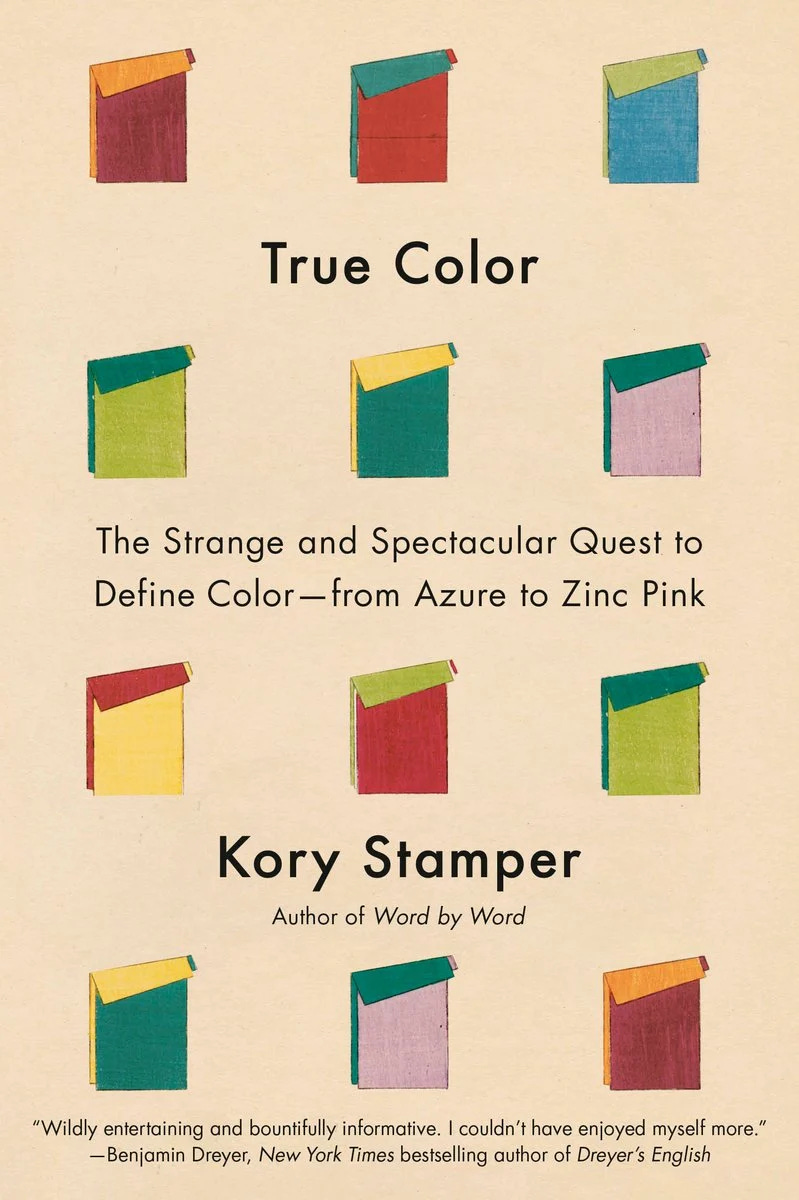
My Strong Language colleague3 Kory Stamper has written a new book, True Color, with a gorgeous cover and a zingy subtitle: “The Strange and Spectacular Quest to Define Color — from Azure to Zinc Pink.” I loved Kory’s first book, Word by Word (I reviewed it in 2017), and am very much looking forward to True Color, whose official publication date is March 31 and whose subject matter is supremely in my wheelhouse. While we’re waiting, here’s Kory’s blog post about the book, here’s an excerpt, and here’s Kory making a guest appearance on the Lingthusiasm podcast.
New portmanteau watch
Gullicism: the “bizarre epidemic of gullibility and cynicism . . . that is drawing people into a world of conspiracism and falsehoods, one where facts are drowned out by a cacophony of extremely loud and wrong voices.” — Adam Serwer, “The Cynical, Gullible American” (The Atlantic gift link)
New word game
From David Josh Wardle, the creator of Wordle, Parseword (nice name!) is a new approach to the famously challenging cryptic crossword. Maybe it will even help me, a fast crossword-solver who’s constantly defeated by cryptics. Learn more from this New Yorker story.4
Not new, consistently excellent
I’m sure I’ve mentioned it before, and I’m going to mention it again: Robin Sloan’s monthly newsletter is an utter joy. This month his subjects include trains, Japanese trains, train stationery (!!), Japanese fiction, the Computer History Museum, and India street lettering. Note to self: Must finally read Sloan’s 2012 novel Mr. Penumbra’s 24-Hour Bookstore.
Personal-name watch
I don’t write about them, but I often enjoy reading about them.
“Why did people start naming their kids things like ‘Markwayne’?” — David Mack, Slate
“How did Yehudi Menuhin get his name?” A much more interesting story than you might expect. — Nancy Man, Nancy’s Baby Names
“The rise of Liam” - Liam Brennan, ARC
“The sociology of baby names”: Hannah Emery, PhD in conversation with Anne Helen Petersen on the Culture Study podcast.
And here’s something I wrote back in 2019 about my complicated relationship with my own name: “My Name and I: A Hate-Love Story” (gift link).
Advice for writers
“There’s a business concept called ‘lifetime value’, LTV, that refers to the amount of money a business can expect to make from a new customer on average over the duration of the relationship. For a writer, the LTV of a Substack subscriber is many times higher than the LTV of a book buyer.” — One Thing, “The Difference Between Substack and Books”
Naming advice for new business-owners
Caitlin Barrett, a professional name developer, offers ten tips, including “Prepare for an emotional journey” and “Don’t stop with one name.”
“Bad decisions make good stories”
I’m a huge film-noir fan but not much into the true-crime genre, which may explain why “The Film Noir Fate of Kouri Richins,” by Farran Smith Nehme, aka Self-Styled Siren, was news to me. It’s a doozy.
Alien lingo
Speaking of movies, did anyone else wonder about the alien language spoken at the end of Bugonia? (Sorry if that’s a spoiler.) I asked about it on the American Dialect Society listserv, and Ben Zimmer promptly supplied an answer: It’s the work not of a linguist but of sound designer Johnnie Burn, who also designed sound for Hamnet (“overbearingly, imo,” Ben notes; I agree) and The Zone of Interest. “Bugonia sound designer learned the ‘musical pitch’ of bees to create a paranoid soundscape” (Entertainment Weekly). Ben adds: “This follows in the tradition of sound designer Ben Burtt, who created the ‘languages’ of the original ‘Star Wars’ series.”
Aluminum or aluminium?
Ben Yagoda on the history of the metal and its divided spelling. - Not One Off Britishisms
Punctuating f’ake f’ood
Click on the image to see the Instagram slides. This is a subject I’ve been obsessed with for many years.

Branding isn’t static
“Nokia used to make toilet paper and rubber boots. Listerine used to be sold as a floor cleaner and cure for gonorrhea.” A Hundred Monkeys, “Branding in Late Stage Capitalism”
Branding is sometimes stupid
“I finally understand this Tara Lipinski commercial.” Lauren Theisen, Defector (hat tip Cheryl Wischhover)
Where do words come from?
Probably not from Shakespeare. — Colin Gorrie, Dead Language Society. (And if you haven’t read Gorrie’s “How Far Back in Time Can You Understand English?” — published February 18 and circulated far and wide — here’s your opportunity.)
And finally: A day in the life of an enshittificator
Make It Shitty, Norwegian Consumer Council (in English)
Although why not Godwin’s Laws or Godwin’s Loss or Godwin’s Flaws or … I’ll see myself out now.
Among ourselves we use “co-fucker,” but that tends to get misconstrued.
The otherwise good story contains one of my current peeves, the intrusive “so.” As in: “American, or ‘concise,’ crosswords are typically exercises in trivia more so than wit.” (Boldface for shaming.) What is so doing there? Get rid of it. (At least he didn’t spell it moreso. Ugh.)
I'm a little over halfway through my advance copy of True Color, and I am enjoying it immensely.
I pre-ordered True Color and cannot wait.