
Words of war
From "Epic Fury" to "very complete, pretty much."

What’s it called?
I’ve been keeping track of language associated with the current Middle East conflict, starting with what we’re supposed to call it. Definitely not a war, because who could forget that Trump the candidate campaigned on no more foreign wars. Yes, his Department of Defense was (unofficially and expensively) renamed the “Department of War,” but everywhere else the W-word carries some nasty baggage. “For most people, after the experience of Iraq and Afghanistan, war is just another word for ‘quagmire’,” writes Gal Beckerman in The Atlantic. So . . . “strategic strikes”? “Targeted major combat operations”?
Or maybe it is a war after all: a “war of choice,” as opposed to a “war of necessity.” That’s what Senator John Warner, Democrat of Virginia, is calling it, echoing the title of Richard Haass’s 2009 memoir of the two Iraq conflicts. As late-night host Stephen Colbert wryly put it, “It’s worse than a war. It’s a war that got a thesaurus for Christmas.”
A commenter on TheAtlantic.com had an even bitterer take:
These clowns are waging a multi front war: a war on reality; a war on facts; a war on grammar; a war on semantics; a war on probity; a war on morality; a war on empathy; a war on foreign and domestic brown people. Let’s hope they lose all these, even as losing the Trump/Netanyahu Iran War makes losers of us all.
“Epic Fury”
The warfighters at the so-called Department of War would like us to call the whole thing “Epic Fury,” the name assigned by the Pentagon to the attacks on Iran that began on February 28, 2026. That’s fury as in — quoting Merriam-Webster here — “intense, disordered, and often destructive rage” — and epic as in either “large and sweeping” or slangy “awesome.”
Congressman John H. Rutherford, Republican of Florida, misspelled it “Epic Furry” in a press release.
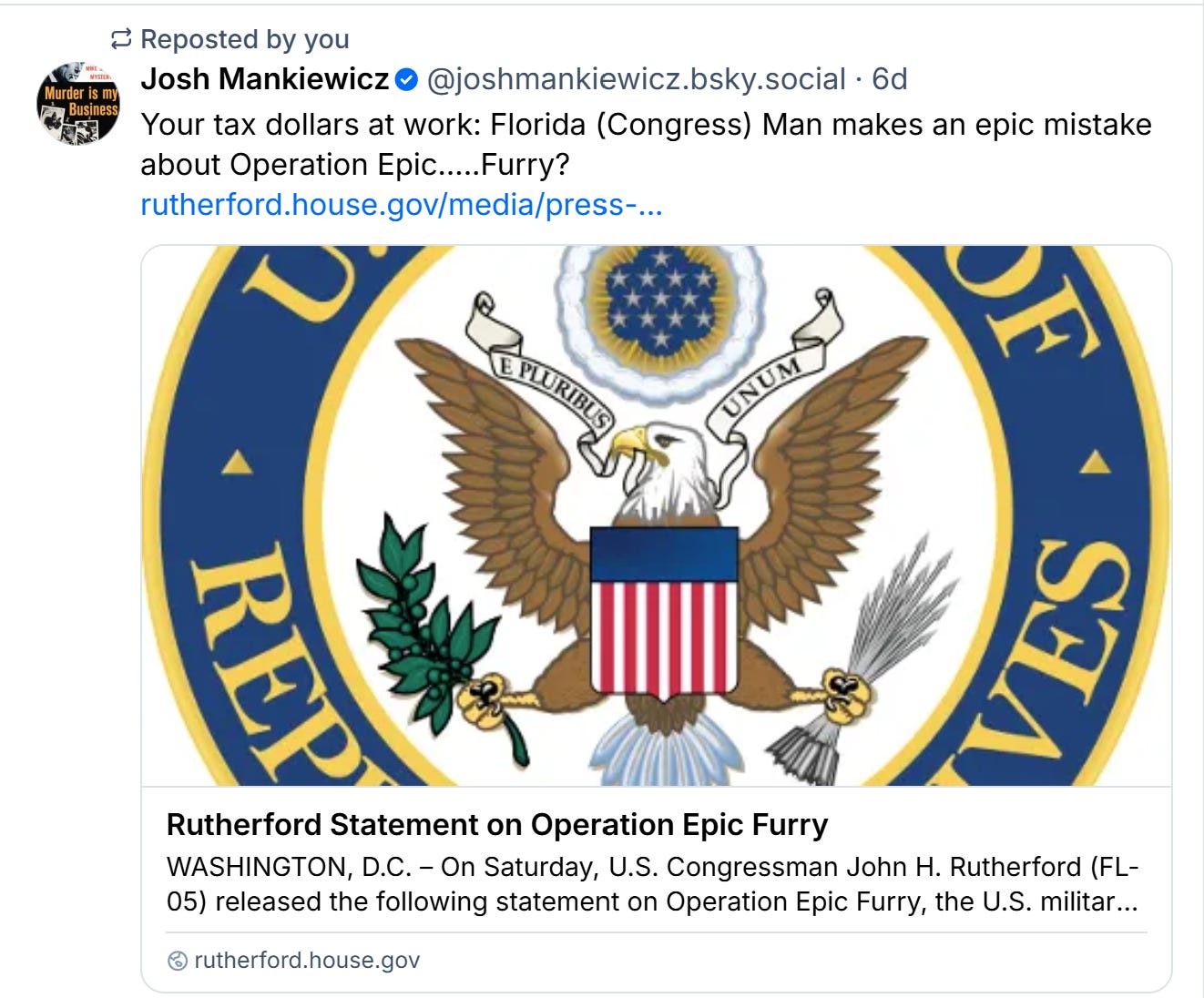
Does “Epic Fury” sound like the title of a video game or the fifth installment of an action-movie franchise? Either interpretation would no doubt please the current administration, and especially the former talk-show host who heads the Department of Defense/War. See, for example, an official White House “hype video” in which, as The Guardian observed, a player from Grand Theft Auto “strolls down the street as the video jump-cuts to periscope footage of a US torpedo destroying an Iranian warship. ‘WASTED,’ the screen announces.”
CNN made epic its word of the week on March 4 and called on linguist, lexicographer, and radio host Grant Barrett to amplify our understanding:
The operation’s name, then, continues the Pentagon’s practice, under Secretary of Defense Pete Hegseth, of veering rhetorically between military jargon like “kinetic” and internet-brawler aggression like “FAFO.” If “epic fury” is meant to convey a great magnitude of aggression, Barrett says it also evokes the internet-era expression for when someone crashes and burns spectacularly: “I think for most people, it calls to mind ‘epic fail.’”
(As far as I know I am not related to Brandon Friedman.)
Many cynics among us dubbed the operation “Epstein Fury”: a distraction from the damning revelations in the Jeffrey Epstein files. Other terms in wide circulation: mess, debacle, disaster.
Maven (again)
In Yiddish, and especially American Yiddish, a maven is a self-proclaimed expert. In branding, it’s an increasingly popular brand name for enterprises with no connection to Yiddish. (There are more than 250 live MAVEN trademarks.) The Maven in the news right now is Palantir’s Maven Smart System, which combines “artificial intelligence (AI) and machine learning (ML) to revolutionize targeting and logistics operations for the U.S. Army.” (You remember Palantir: co-founded and chaired by Peter Thiel; named after a “seeing stone” in The Lord of the Rings.)
Maven Smart System had incorporated tools built by the AI company Anthropic, but after the Department of Defense/War declared Anthropic a “supply chain risk” — a label never before applied to a U.S. company1 — Palantir was forced to make some quick changes. (The Simply Wall Street newsletter called this a “mix of product disruption and contract momentum,” a fine example of buzzword obfuscation.)
For more on the spread of “maven,” here’s a gift link to “So Many Mavens,” my Medium story from 2024.
Very complete, pretty much
On March 9, after global stock markets had declined precipitously and the price of oil surpassed $100 a barrel, Trump declared the war “very complete, pretty much.” Maybe he was bored with it. Or maybe it was yet another example of TACO: Trump Always Chickens Out.
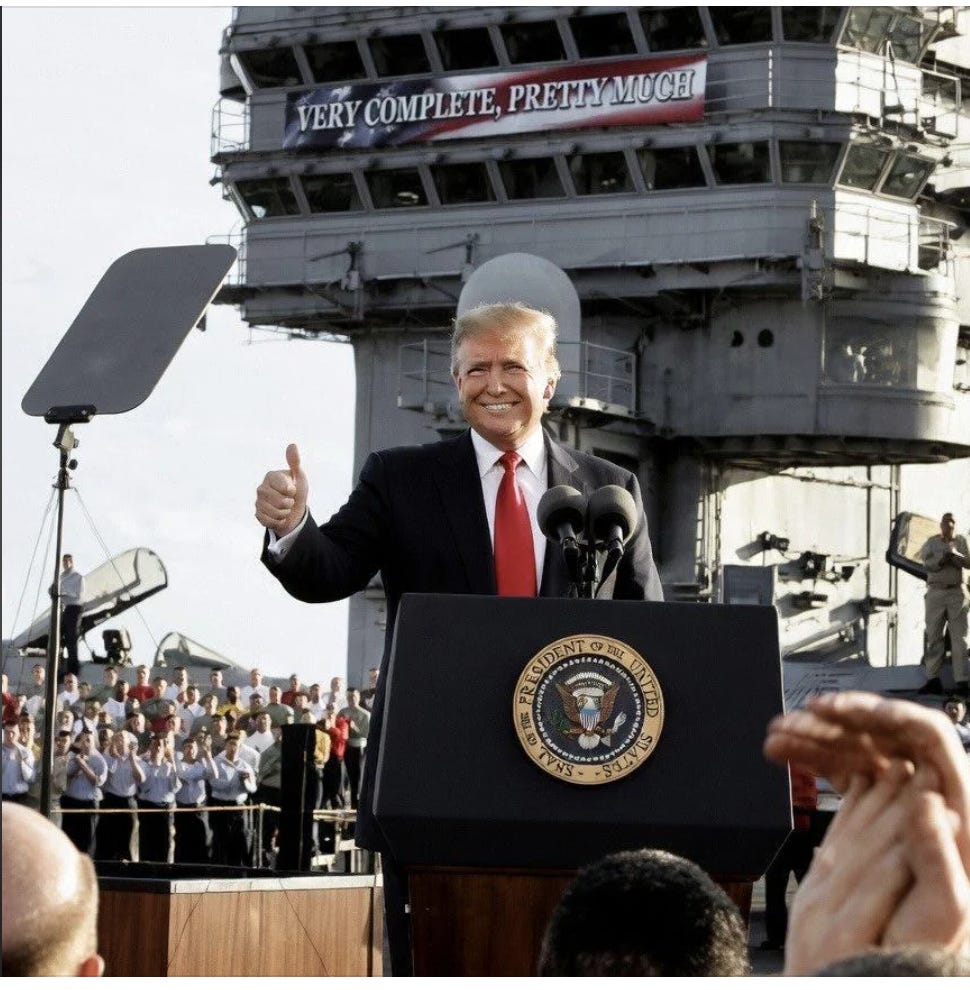
Or . . . who knows.
Related
Further reading
Reading the Pictures on images used to illustrate New York Times opinion pieces about the Iran war.
James Fallows, presidential speechwriter in the Carter Administration, on the long view.
Carole Cadwalladr, coiner of “broligarchy,” on “the hyper-masculine meme-ified fantasy of war.”
Parker Molloy on “Schrödinger’s War.”
Gal Beckerman, “Just Don’t Say the W-word,” The Atlantic gift link.
New York Times, March 9: “Anthropic, which is based in San Francisco, said it did not want its A.I. to be used in mass surveillance of Americans or for autonomous lethal weapons. The Pentagon said a private company could not establish policy for the U.S. government.” Anthropic has filed two lawsuits against the DoD.
I am epically furious.
You unScrabble the insanity.