
November linkstack
My Black Friday gift to you: news about names, brands, language, and culture.

We’ve made it past (U.S.) Thanksgiving, hurrah. Time to catch our collective breath and catch up on some of the interesting stuff I’ve come across on Substack and beyond. This month: words of the year (WOTY), Japanese words for rain, a new dictionary, animal insults, SantaCon, and more.
To read previous linkstacks, start here. And to read this post in full, switch to a browser or the Substack app.
Want more Fritinancy? Follow me on Bluesky, Instagram, Pinterest, and LinkedIn. Find my complete Substack archive here. Read my old Typepad-now-WordPress blog, also called Fritinancy, here. And don’t forget to tap or click the little heart on this post to let me know you liked it.
WOTY countdown
“No matter the formula, selecting one word to define a year is serious business. It’s about the sharp lines of language and usage, how society adopts and spreads new terminology, and, increasingly, the dramatic ways that social media influence the way we write, talk, and interact.” - “Choosing the Word of the Year Is No Easy Feat.” (Stefan Fatsis for Literary Hub. I’m mentioned; thanks, Stefan! )
In the U.S., you can submit your nominations for the 2025 word of the year to the American Dialect Society. Last year’s ADS WOTY was rawdog; the 2023 pick was enshittification. Be sure to read the nomination rules! The final vote will be held January 9 in New Orleans; the outcome will likely be based, as Stefan Fatsis puts it, “on vibes alone.” (American Dialect Society)
Voting closed yesterday in Oxford University Press’s WOTY poll, but you still have time to read about OUP’s shortlist: aura farming, biohack, and rage bait.
I’ll be posting my own WOTY picks in mid-December1; in the meantime I’ve enjoyed reviewing Brianne Hughes’s list of potential candidates, which include quite a few — including autobesity, polyworking, samba whisk — that are new to me. (Wordnik)
Australia’s Macquarie Dictionary chose AI slop as its word of the year. “I applaud the choice — but was bored by the shortlist,” writes Roslyn Petelin, a faculty member at the University of Queensland. (The Conversation) I wrote about AI slop in November 2024:
Attention, Canadians: The Canadian English Dictionary seeks your vote for its Canadian word of the year (CWOTY). I’m not eligible to participate, but I confess to a fondness for “maple-washing” based on my long-documented interest in -washing compounds. The poll closes at 11:59 p.m. ET on December 5. Hat tip: Gretchen McCulloch and Mike Pope.
In the UK, Cambridge Dictionary chose parasocial as its WOTY, with this definition: “a relationship felt by someone between themselves and a famous person they do not know.” (BBC; hat tip: Lynne Murphy)
Another UK dictionary, Collins, picked vibe coding: “AI meets authenticity as society shifts.” I wrote about vibe coding in September:
How they got that name
What the heck is a smoot? (Word Origins)
Where did we get podcast? (The Guardian from 2004, tracked down after reading about a new documentary about the history of podcasting, The Age of Audio, on Kottke)
How did Acer, eBay, Garmin, and a bunch of other companies get their names? This post was last updated in 2016, but it’s still of interest to name nerds like me, and maybe you. (Alan Brew, Namedroppings)
Gifts, you say?
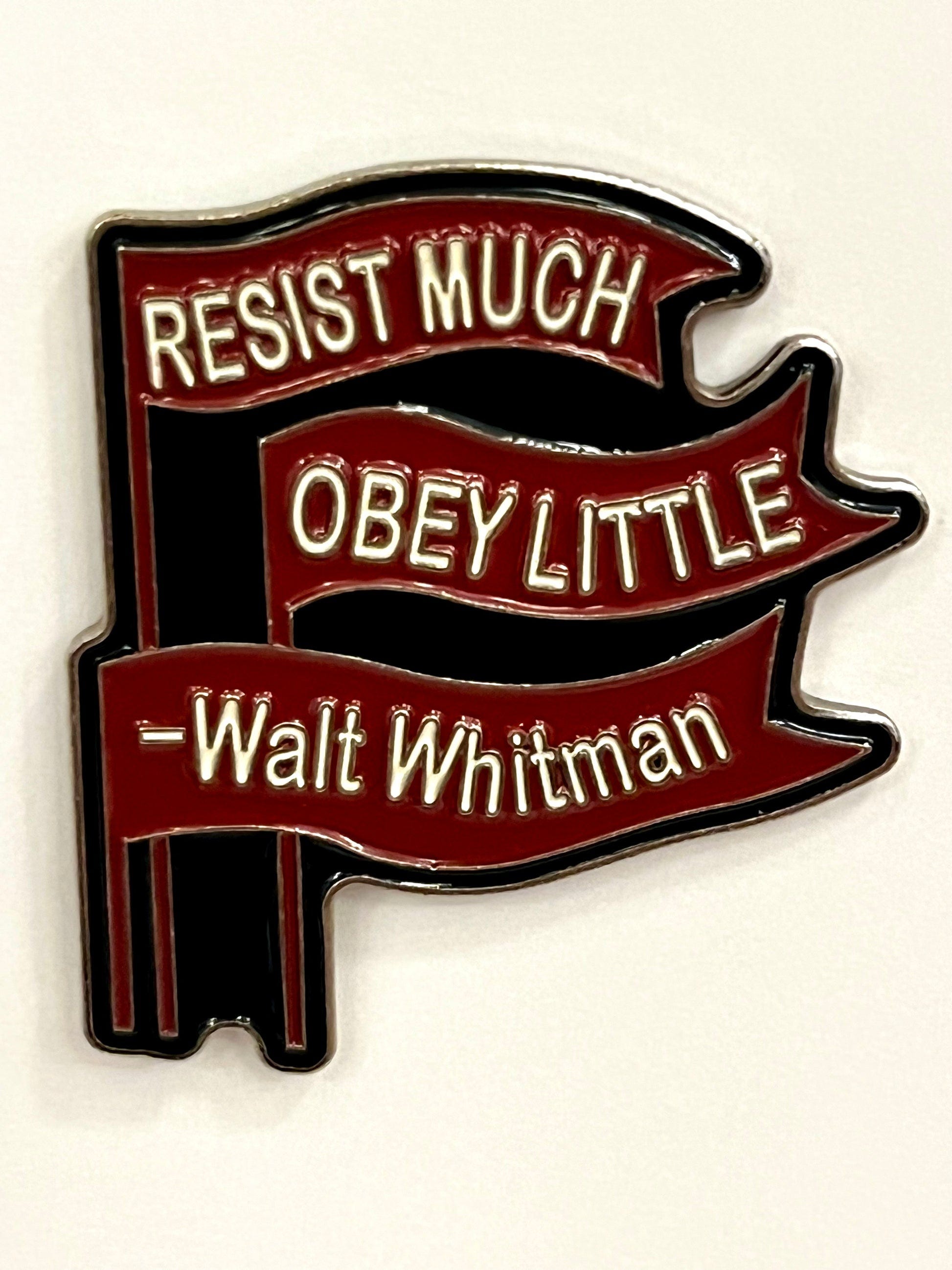
The New York Review of Books has some nifty ones, including a nice-looking Collective Noun Animals Tea Towel and this inspiring and sturdily crafted enamel pin, which I bought for myself and have been wearing with pride.
Novelist Robin Sloan, author of a terrific newsletter, has compiled a splendid gift guide that includes seaweed salt, laser-cut-steel hooks in yummy colors, the spiral-bound Tidelog, San Francisco–crafted Dandelion chocolate (I can vouch for its excellence), and a bunch of books I need to read, including Keith Houston’s The Book, “an X-ray of a powerful machine, and a chronicle of the people who refined and reengineered it over the centuries.”
More books!
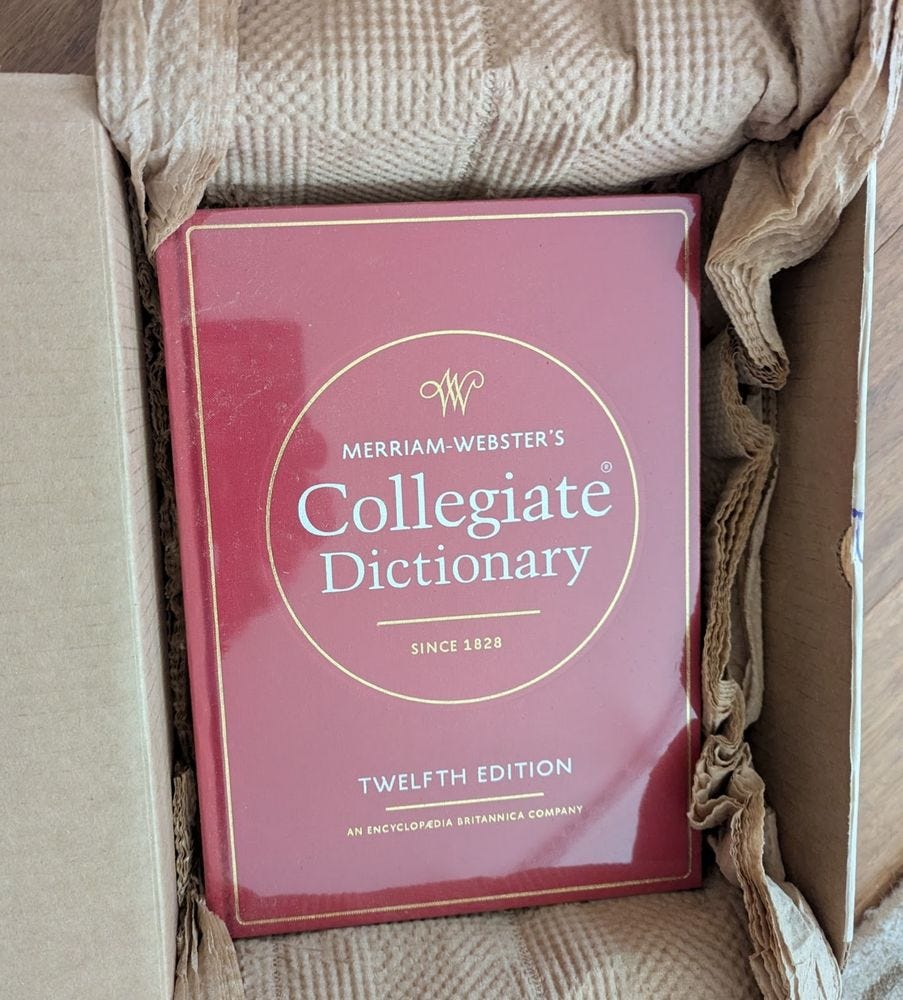
Grammar Girl (Mignon Fogarty) talked with Merriam-Webster editor-at-large Peter Sokolowski about the new 12th Collegiate edition — the first new Collegiate in 20 years. (YouTube, Apple podcasts, et al.)
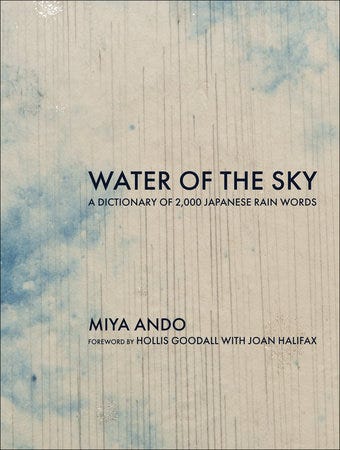
Emori is the Japanese word for “rain that leaks through the umbrella.” Fuchikunun is “rain that comes indoors.” These and 1,998 more Japanese words for rain in Water of the Sky, by Maya Ando, new from Penguin Random House.
What’s the name of the year?
The Namerology blog wants your nominations. I’m torn between Zohran Mamdani and Shohei Ohtani.
And speaking of New York City’s new mayor
“A rich tapestry is woven into Zohran Mamdani’s last name.” (Asia Times)
Old typefaces are new again
Serif fonts like Baskerville are “taking over tech companies and the White House.” (Wall Street Journal via Kyle Chayka’s One Thing newsletter; Keya Vadgama wrote about the “serif renaissance in AI branding” back in March.)

Beastly insults
“Piggy,” the insult hurled by our ever-so-tactful president at a Bloomberg news reporter who dared to ask him a question, is “devoid of nuance” and “generic,” sniffs Barbara Wallraff. She compiled an alphabetical bestiary of animal insults, from aardvark to zebra, that includes “more inventive possibilities.” (The Wordshop)
Weird welcome
Why are restaurant and retail employees in the U.S. saying “welcome in” instead of just “welcome”? (Washington Post)
A reason (maybe) not to loathe SantaCon
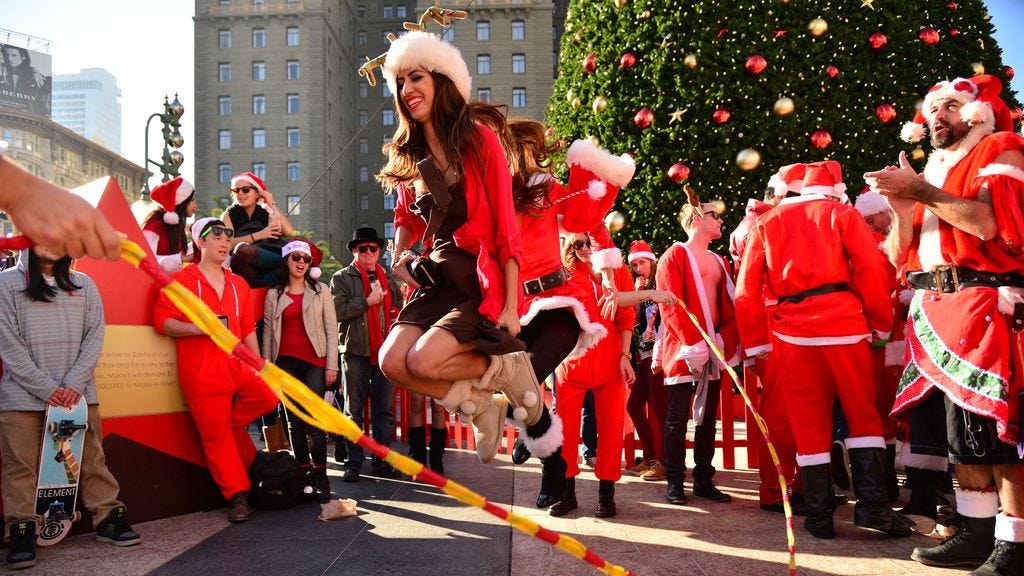
Anna Merlan dives into the history of “America’s most hated Christmas party,” the subject of a new documentary. The event began in San Francisco in 1994 as a Merry Prankster–esque caper: “While the event is best known today as a Christmas season bar crawl, at the time, the Santas involved were all connected to the Cacophony Society, a group of artists, urban explorers, and troublemakers with chapters in several cities.” They also had ties to Burning Man. (Mother Jones) (Watch the documentary trailer)
Typewriter men
I’ll close this edition with a good-news story about some old technology: “How to Fix a Typewriter and Your Life,” by Kurt Streeter (New York Times gift link; hat tip Dave Pell). It’s about Paul Lundy, a dissatisfied Seattle-area facilities manager who switched careers after he met a 92-year-old typewriter repairman.
In the comments, Streeter adds this note:
Just for the experience I drafted an early version of this story on a shiny, black 1930s Corona Paul Lundy lent me. It was a fascinating experience that took...well, I’ll just say “multiple” days...and left me feeling like several of my fingers were about to fall off. My biggest takeaway from working on that beautiful machine was recognizing the immense patience and focus required to avoid scarring the typing paper with errors. Paul discusses the Zen of fixing typewriters in the piece, but that same mental state is essential for successfully operating an old manual like that Corona. If my attention wandered, even slightly, an error invariably seemed to follow, and since I avoided white-out, my mistakes were left ugly—covered by XXXXX or BBBB. This was a million miles away from thoughtlessly cutting and pasting on my MacBook Pro. It was like the typewriter was holding a mirror up to my very modern lack of attention.
I posted my words of the year (so far) in May.
Reading your stuff is on my gratitude list. Thanks!
Name of the Year: Big Balls.