
July linkstack
Odyssey critiques, a tuna mascot, AI dread, two-letter restaurant names, and more.

If you’re just joining us1, Linkstack is my monthly roundup of interesting things I’ve read, watched, or listened to on Substack and beyond. Here’s the June linkstack, and here’s my entire Substack archive back to August 2023. This is a long post with lots of images; it’s best viewed in its entirety in your browser or the Substack app rather than in your email inbox.
A reminder: On August 10 I’ll be introducing paid subscriptions. Here’s the story:
A progress report

On August 9, 2023, some seventeen years after I began blogging, I published my first post here on Substack. It took a little less than a year to reach the 1,000-subscriber mark. I’m happy to report that my readership now stands at more than 2,600 subscribers and more than 2,700 “followers” (readers who see my stories and notes on the app but don’t recei…
Odysseys
I saw Christopher Nolan’s The Odyssey. I was . . . whelmed. I’m happy that people of all ages are showing up in person, in droves, to see a movie based on a 3,000-year-old poem. I was impressed by the technical skill. I admired some of the imagery. But I’m not a fan of mopey Odysseus or sexless Calypso, or of the heavy overlay of Christian guilt (despite all the yapping about “Zeus’s law”).
But don’t take my word for it:
“What We Lost When We Made the Odyssey Modern”: Derek Thompson interviews classicist Emily Wilson, whose 2017 translation of Homer’s epic poem is a source for Christopher Nolan’s epic movie. Wilson’s Odyssey is the only translation by a woman; it’s where the film derives its contemporary language like “dad” and “tote bag.” Wilson published a longer version of the interview on her own Substack newsletter.
“An Uncomplicated Man”: Emily Wilson writes in the London Review of Books that “I would be ashamed to have written any part of this script. Sadly, Damon’s Odysseus isn’t complicated or wily or artful.” The film, she goes on to say, “has nothing convincing to say about time, memory, history, war, or about the relationship between one warrior’s glorious return and the lives of his family, adversaries, comrades, friends and neighbours. It lacks psychological, emotional, political and ethical depth. Its narrative structure is gimmicky. The writing is abysmal. None of the characters has convincing motivation for their actions or words. There are no sex scenes, and all the food looks horrible.” (ht Kottke)
Daniel Mendelsohn’s translation of The Odyssey was published in 2025. He spoke to the New York Review of Books’ “Private Life” podcast about other film adaptations of The Odyssey, and returned to NYRB a week later with “Artful Weaving,” a review of the new movie in the context of Nolan’s other work: “[L]ike the sack of unruly winds that Aeolus, the divine custodian of the winds, entrusts to Odysseus in book 10—only to have it opened by the hero’s suspicious crewmen, with disastrous results—it is in the end a mixed bag: at once a vehicle for the director’s virtues and, as with The Return, a case study of the weaknesses inherent in attempting to modernize a work many of whose values remain, for all its timelessness, stubbornly archaic.” (Subscriber link, archive link). I watched The Return on Hulu last year and wrote a bit about it, calling it “slow-moving but strangely stirring.”
Where does “Odysseus” come from?
And why did the Romans call him “Ulysses”? (John Kelly, Mashed Radish)
Parasites then and now
From The Odyssey’s Suitors to cyclospora: “The original definition of parasite or ‘parasitos’ comes from Greek, literally translating to ‘alongside of (para) grain or wheat (sitos). The ancient Greeks used the word to describe someone, usually poor, who would entertain a wealthy person for food.” (NPR)
Not sorry, Charlie
Everyone’s talking about “taste” (including me), so why not bring back Charlie the Tuna, StarKist’s 65-year-old good-taste mascot? “There’s a debate in the industry now about whether brand mascots are still a thing. I would argue that if you use them effectively, they’re more powerful than ever,” said Dooley Tombras, president of the ad agency heading the “social-first” brand refresh. (AdWeek) More about Charlie on the Ad Mascots wiki. (I hadn’t known that Charlie was originally voiced by Herschel Bernardi, who played Tevye in Fiddler on the Roof on Broadway.)
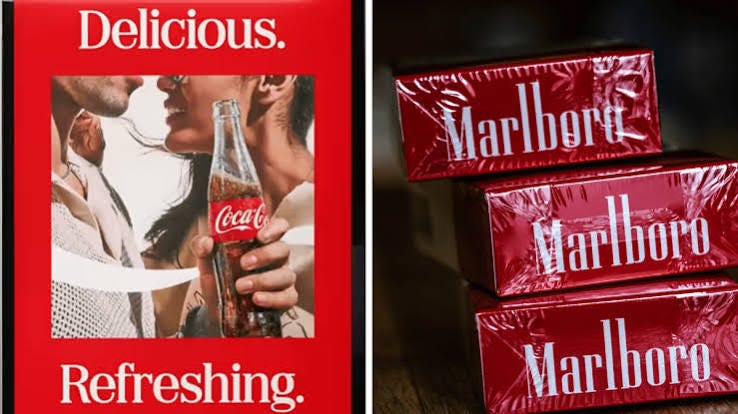
Have a fridge cigarette and a smile?
Coca-Cola’s new serif typeface is reminding some people of another addictive product. Judge for yourself. (Fast Company)
“AI dread” in San Francisco
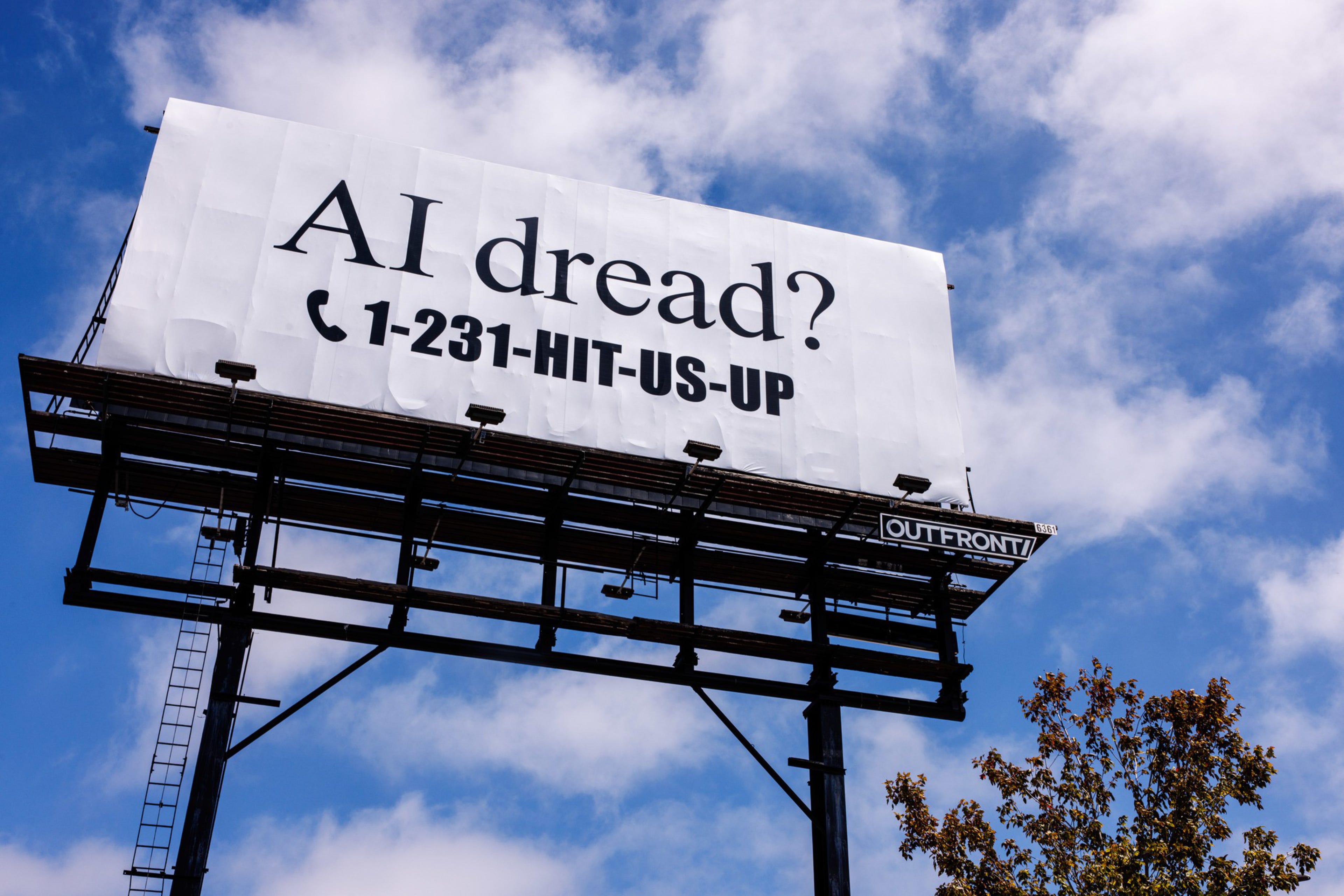
The new billboards, which I’ve been spotting around town, are “the latest example of tech companies using anti-AI language to make its own AI go down easier — not by pitching you its tools, but by talking you off the AI-dread ledge.” (San Francisco Standard)
Another tell in AI writing
It’s not just the em dashes, it’s also “negative parallelism.” See what I did there? (The Atlantic gift link)
The makeup of makeup
“Why paint the gaping maw of your mouth with a gloss that recalls the gaping maw of eternity?” Jessica DeFino discovers three lip glosses called VOID, a word that can also mean “to eliminate waste from the body.”
Essential vocabulary then and now
Data designer Jasmine Nackash on what changed between 1953 and 2023 in the words taught to English-language learners. “Humble, loyalty, fellowship, generous, polite, and companionship gave way to community, identity, organization, ethnic, gender, and narrative.” (The Pudding; ht Kottke)
World Cup words
British grammar invades the American World Cup — as in “England are losing.” With quotes from Lynne Murphy and Grant Barrett. (Zach Helfand for The New Yorker; archive link)
Ben Yagoda wrote about British vs. American stress patterns: “half time,” “red card,” and so on. (Not One-Off Britishisms blog)
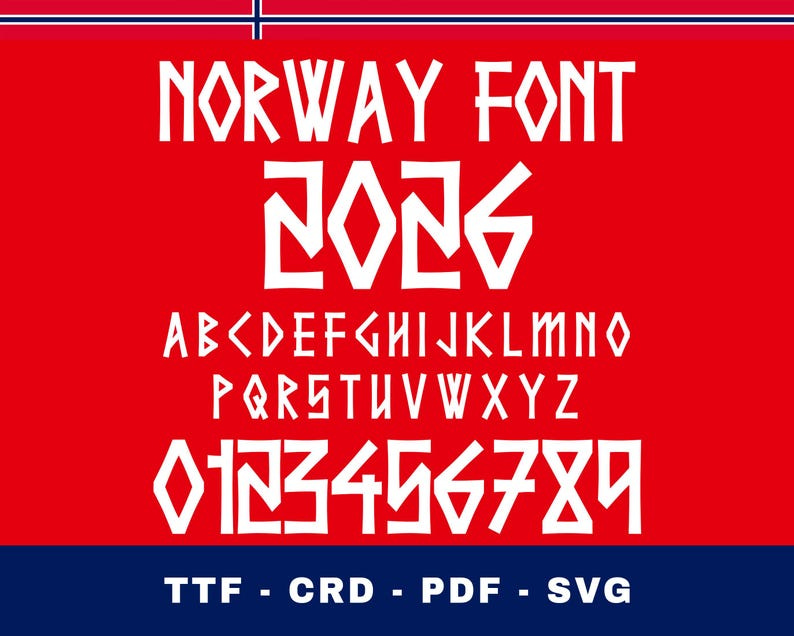
The numerals on Norway’s Word Cup uniforms were inspired by Viking-Age runes. (Fast Company; ht Howard Mittelmark)
Puzzle time
Seven things A.J. Jacobs learned from puzzle master Will Shortz. One of them: Shortz created the New York Times’s hugely popular Spelling Bee puzzle in 2015, inspired by a game called “The Polygon” in The Times of London, “but he made some important changes: In Will’s version, you can use a letter more than once. And then there’s the clever title and packaging. It makes a huge difference that the title is a pun and the layout contains beehive-like hexagons.”
“Factoid” facts
“Factoid has split into two nearly opposite meanings.” (Jay Heinrichs)
News you can’t refuse
And speaking of facts, did you know that Harper’s Magazine publishes a weekly review on Substack “taking aim at the relentless absurdity of the 24-hour news cycle”? It’s where I learned that “in the Bay Area, Pixar used Mrs. Incredible–themed letterhead to announce the layoffs of more than 100 workers.”
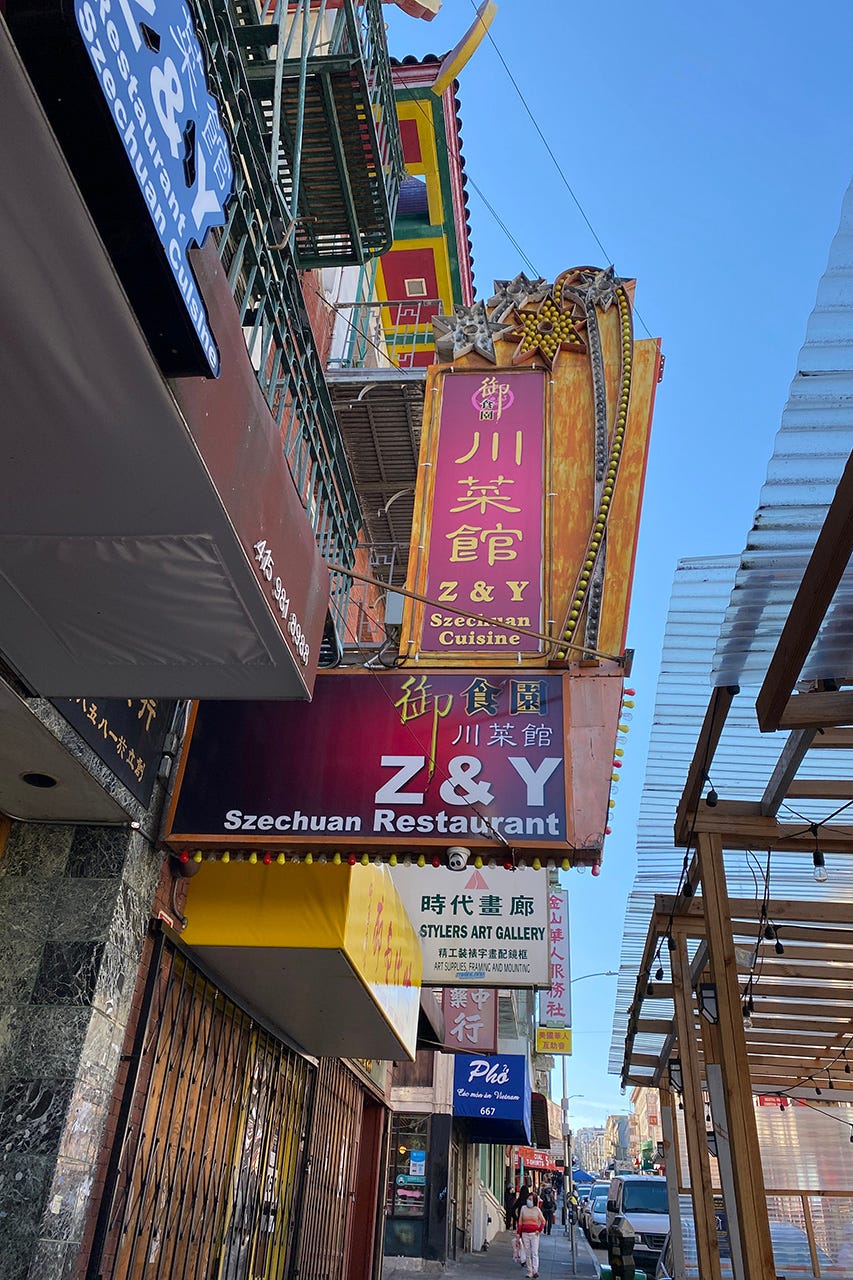
From AA to Z & Y
Why do so many San Francisco Chinese restaurants have two-letter names? MacKenzie Chung Fegan investigates. (Bite Curious, San Francisco Chronicle)
Why I still look at LinkedIn
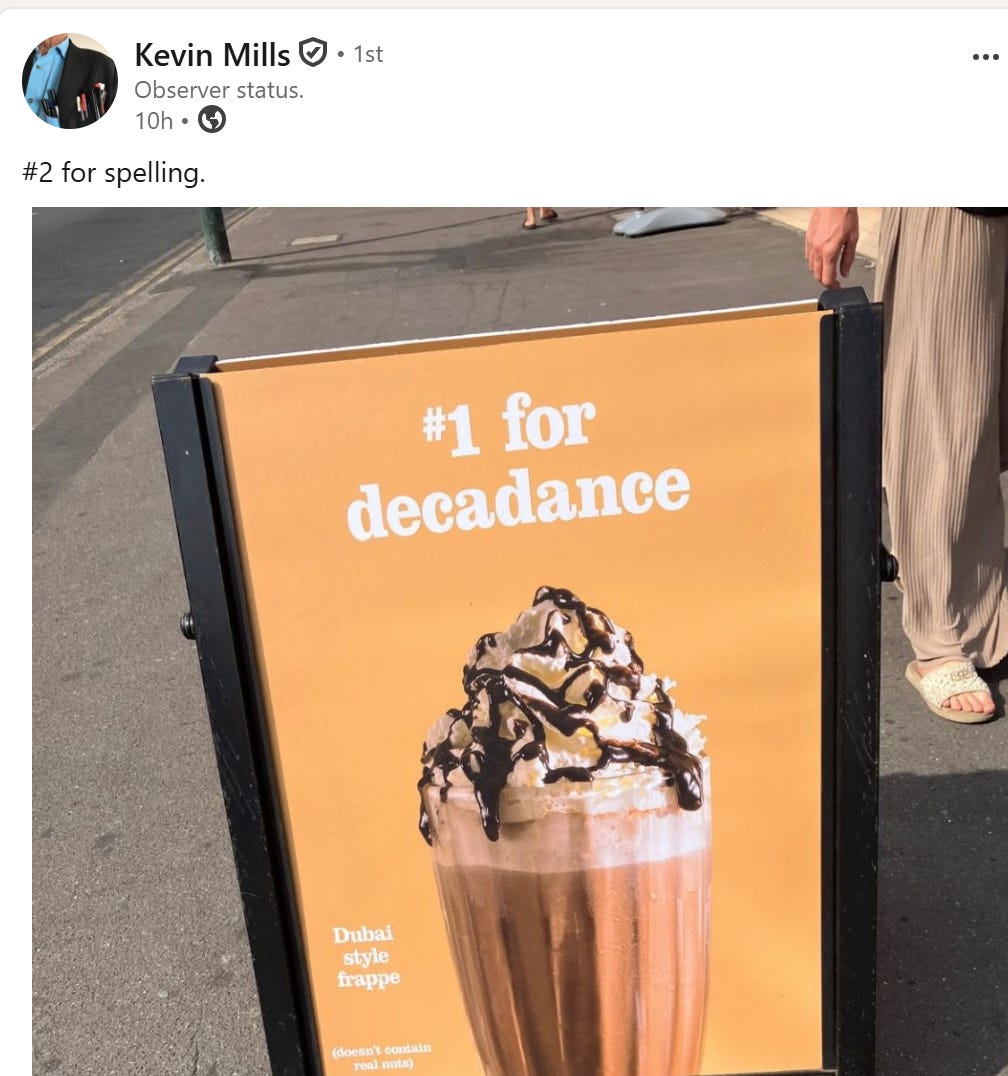
Because that’s where I find posts like this one from UK copywriter Kevin Mills:
Look, I made a biscuit conditional!
This might be my new way to think about AI (in other words, I'm trying to think about it less!): https://substack.com/@oliverburkeman/note/c-304218347?utm_source=notes-share-action&r=4fsa7