
52 things I learned in 2025
The news (to me) this year.

I had so much fun compiling a “52 things” list last year that I’ve returned with a new edition, once again inspired by Tom Whitwell’s annual compilation. (A favorite of mine from Tom’s 2025 list: “Most characters in the film Idiocracy wear Crocs because the film’s wardrobe director thought they were too horrible-looking to ever become popular.”)
The Atlantic got in on the act this year, too, with “55 facts that blew our minds in 2025” (gift link). Here’s one I liked: “The jingle for Pepsi-Cola was the most recognized tune in America in 1942, according to one survey.” (See my February 2025 post on jingles; gift link)
Here’s my own 2025 list: 52 things, one for each week of the year, mostly but not exclusively related to words, names, brands, and commerce.
This newsletter is almost certainly too long for email. Click on the headline for a browser view or switch to the Substack app.
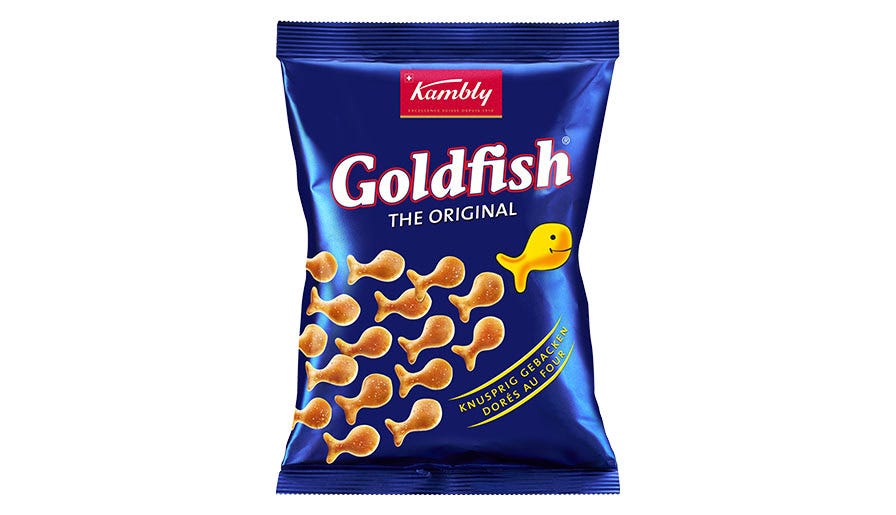
The Goldfish crackers name was inspired by astrology. In 1958 Oscar Kambly, owner of the Swiss company Kambly, created Goldfish as a birthday gift for his wife, whose astrological sign was Pisces, the fish. (Several years later, Margaret Rudkin, founder of the U.S. baked-goods company Pepperidge Farm, discovered Goldfish on a Swiss vacation and acquired the license to manufacture the crackers in America.) (Wikipedia)
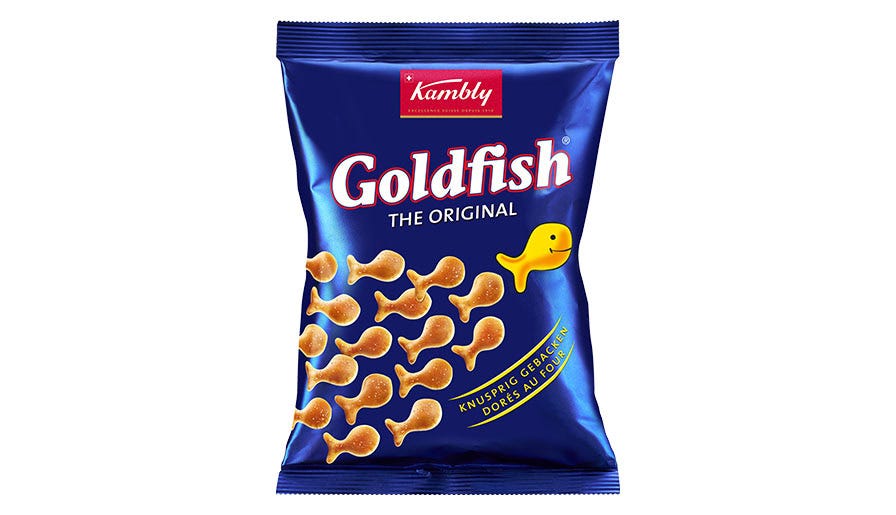
Kambly Goldfish crackers are still sold in Switzerland. In the U.S. the brand’s slogan is “The snack that smiles back.” In Italy a hot-water bottle is sometimes called a mezzo-marito, which means “half-husband.” (New York Review of Books, “A Medicine Ball in Your Stocking”)
Plonk, a disparaging term for cheap wine — usually red — comes from a mispronunciation of vin blanc — white wine — by British soldiers stationed in France during World War I. (Paul Fussell, The Great War and Modern Memory; also in Green’s Dictionary of Slang)
What we now call a zipper was originally called the Hookless Hooker. (Articles Of Interest, “Zippers”)
The Hebrew slang term for what much of the world calls New Year’s Eve is Sylvester. The name was brought to Israel by German Jews for whom December 31 had been known as St. Sylvester’s Day. (Elon Gilad)
Despite its name, about 40 percent of NYC subway system is above ground. (Rob Stephenson, The Neighborhoods)
The Old English gloss for “affable” was “wordwynsum,” which is very winsome indeed. (Etymonline)
The only officially bilingual province in Canada isn’t Quebec. It’s New Brunswick. (Wait Wait … Don’t Tell Me, but I no longer remember which episode.)
Thenar means “relating to the rounded fleshy part of the hand at the base of the thumb.” The word comes directly from Ancient Greek thenar, “palm of the hand.” (Via an answer I didn’t know in the Nomido word game.)
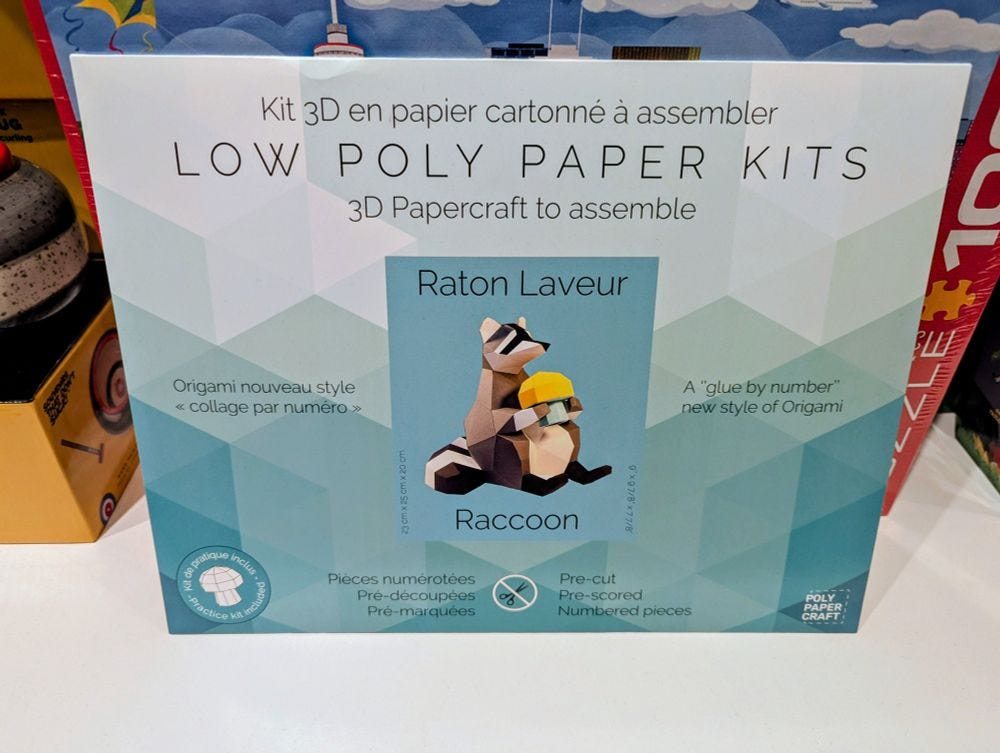
In French, a raccoon is a raton laveur: a washing rat. (Spotted in the gift shop at the Art Gallery of Ontario in Toronto.)
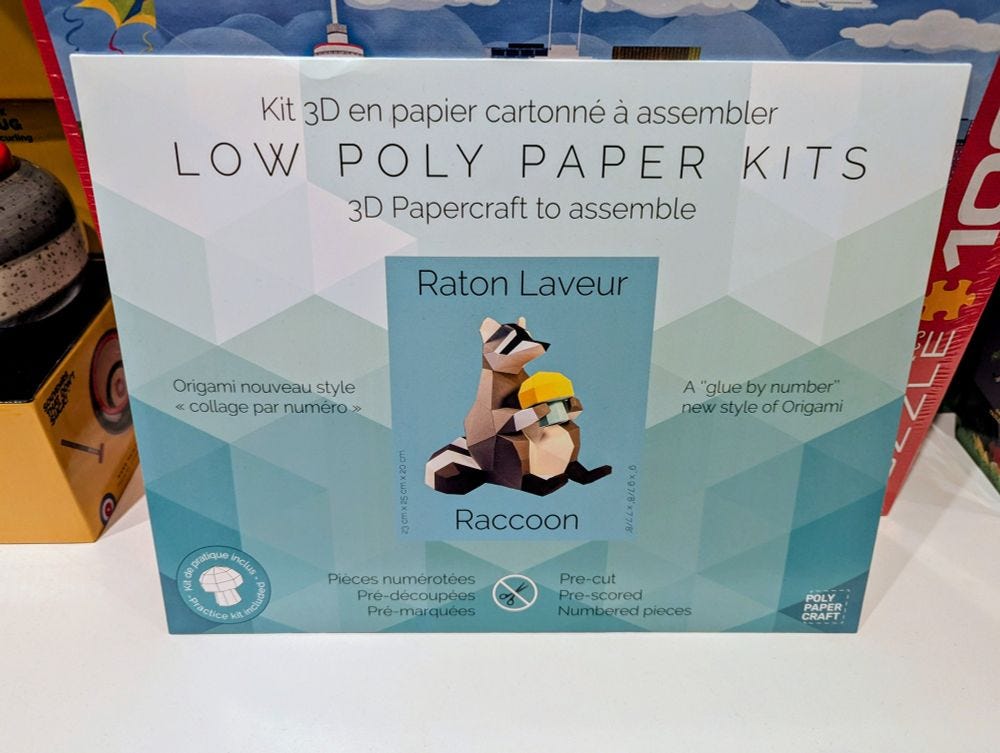
Raton laveur / raccoon. Photo: Nancy Friedman. To lall is to be unable to pronounce L or R sounds. (Another Nomido answer I didn’t know.)
In linguistics, prosthesis is the addition of a sound or syllable at the beginning of a word to make it easier to say, as in Latin status becoming Spanish estado, or the English place name Scunthorpe appearing in the Domesday Book as Escumetorp. (The Allusionist podcast)
Tudum, the name of the Netflix fansite and an annual Netflix festival, is the spelled-out version of the sound that introduces Netflix content. (Yahoo)
Seventy-one percent of people in Iceland are Costco members. (The New Yorker, “Can the Golden Age of Costco Last?”)
Rayon is named for the way rays of sunlight hit the fabric. (Nick Johnson aka nickthrowsafit on Instagram, “The First Synthetic Fabric.”)
Maalox is a brand of antacid for humans. Neigh-lox is the equine equivalent. (Kottke)
Unibare is a Japanese word that means “the moment when someone realizes you’re wearing Uniqlo and not a more expensive brand.” (The New Yorker, “Inside Uniqlo’s Quest for Global Dominance”)
Goethite, a red, yellow, or brown mineral with the chemical formula FeOOH, is the only mineral named for a poet. (Martha Barnette, Friends with Words)
In Sweden, the largest size of Hellmann’s mayonnaise — 600 grams— is called “American size.” (Mark Prus) (Photographic evidence)
Stanford University’s free campus shuttle is called Marguerite in honor of a horse by that name that pulled the carriage of the original Palo Alto-to-Stanford shuttle beginning in the 1880s. (Stanford.edu)
Ritalin, a brand name for the ADHD drug methylpehnidate, was synthesized in 1944 by Leandro Panizzon and named after his wife, Marguerite, nicknamed Rita. (Martha Barnette, Friends with Words)
San Francisco’s Transamerica Pyramid, completed in 1972, is no longer owned by the Transamerica insurance company, nor does Transamerica — headquartered in Baltimore since 2011 — have an office anywhere in San Francisco. But the pyramid symbol is still a registered servicemark of the Transamerica Corporation, which uses it as its logo. (99 percent Invisible podcast)

With originally denoted opposition, competition, or entanglement. The meaning shifted in Middle English to note association, connection, proximity, harmony, or alliance. The original sense is retained in words like withhold (“to hold back”) and withstand (“to stand against”). (Etymonline)
The Vera C. Rubin Observatory, which opened this year in Chile, is the first American observatory to be named for a woman. Rubin (1928–2016), a Philadelphia-born astronomer, did pioneering work on galaxy rotation rates. (NPR)
The class of antibiotics known as rifamycins got their name from the 1955 French gangster film Rififi, directed by the blacklisted American expatriate Jules Dassin. (John Green, Everything Is Tuberculosis; and the National Center for Biochemistry Information.)
The Batman Effect was originally coined after a study found that children ages 4 to 6 exhibited greater determination, confidence, and focus when they wore a cape that made them feel like Batman. Now the sense of the term has been extended to adults: When someone dressed as Batman appeared in the Milan subway, other passengers behaved in a more altruistic manner. (Phys.org)
Awards for excellence in podcasting are called Ambies. The term is derived from “ambient sound” and was coined in imitation of other award names such as Emmys and Grammys. The first Ambies were awarded in 2021. (Wikipedia)
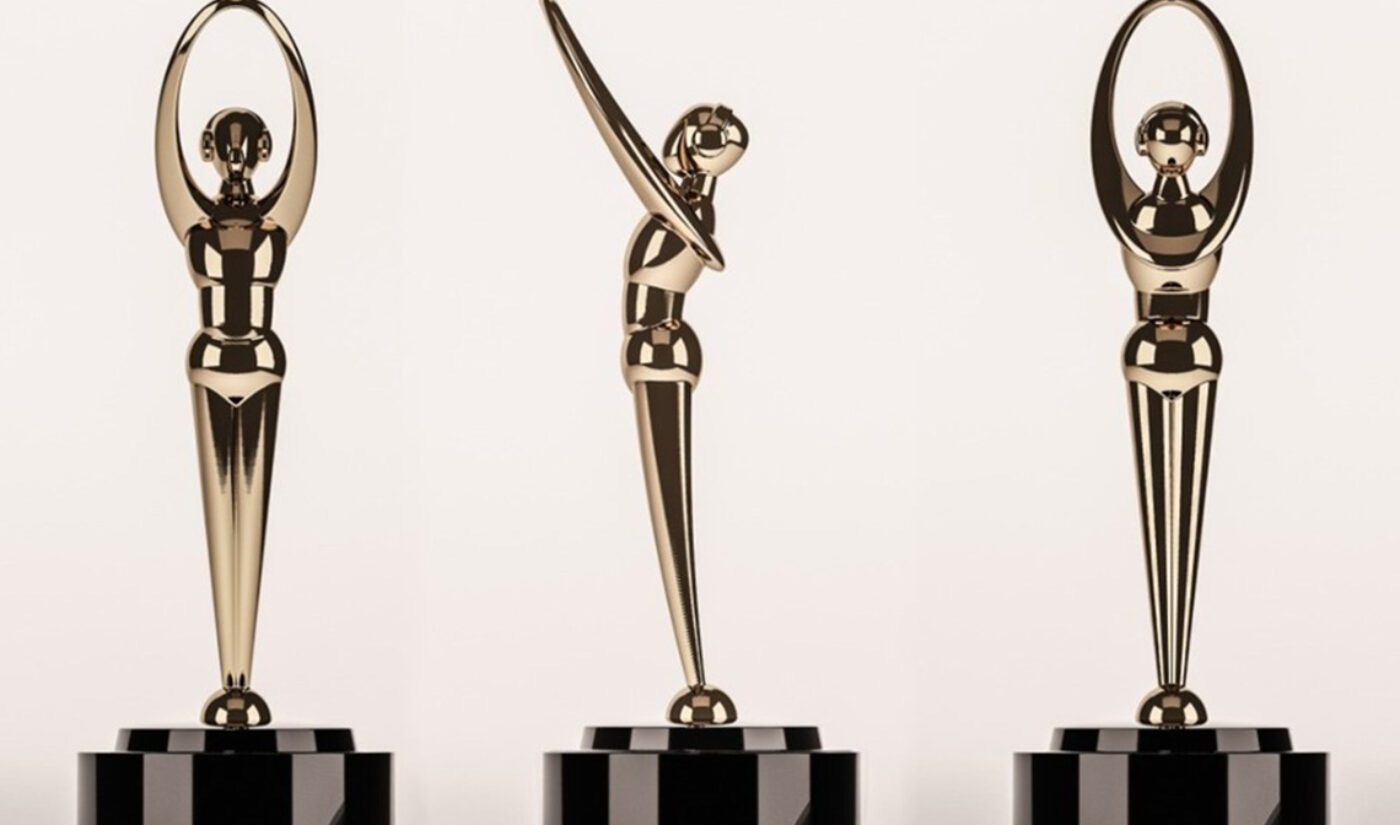
The Jimmy Awards (official name: the National High School Musical Theatre Awards, aka the Tonys for teens) were established in 2009 “to elevate the importance of theatre arts education in schools and reward excellence in student performance.” The “Jimmy” name is a reference to Broadway impresario James M. Nederlander (1922–2016). (Wikipedia)
Hui Dui is the name of the University of Hawaii’s library and information science program. Hui means “partnership” or “union” in Hawaiian; Dui is how Mevil Dewey — creator of the Dewey Decimal System — simplified the spelling of his surname. (Hui Dui)
Pickleball is called pukaball in Hawaii. Puka is a Hawaiian word meaning “hole”; the ball used in pickleball is a perforated sphere. (Wikipedia)
Before Samuel Clemens settled on “Mark Twain” as his nom de plume, he experimented with many other pseudonyms, including Rambler, W. Epaminondas Adrastus Blab, Thomas Jefferson Snodgrass, and Josh. “It’s painful to imagine American literature without the ideal name Mark Twain,” wrote Dwight Garner in his review of Ron Chernow’s new biography of Twain. (New York Times Book Review gift link)
Elon Musk got his name from a 1949 science-fiction novel, Project Mars, by Nazi-turned-American-rocket-scientist Wernher von Braun. In the book, “the Elon” is the Martian leader.1 (Wikipedia; hat tip: Ash_Crow)
“S tier” in gaming — the highest rank — gets its “S” from the Japanese word for “exemplary” (秀, shū). (Wikipedia)
The word miscegenation — marriage or sexual relationships between members of different races, especially when one person is “white” — was coined for the title of an 1863 pamphlet intended to smear Abraham Lincoln’s presidential campaign. (Ghosts of Iron Mountain: The Hoax of the Century, Its Enduring Impact, and What It Reveals About America Today, by Phil Tinline)
Beleaguer is not related to league. The root of beleaguer (besiege, cause problems) is Low German leger (bed, camp, army, lair). The root of league (association) is Latin ligare (to bind.) The old unit of distance called a league (anywhere from 3.9 to 4.6 kilometers) is unrelated to either of those words; it comes from Late Latin leuga. (Reddit)
Steven Soderbergh operates the camera on his films and also edits the footage. He often uses the aliases “Peter Andrews” (DP) and “Mary Ann Bernard” (editor); Peter Andrew Soderbergh is his father, and Mary Ann Bernard Soderbergh is his mother. (Filmmaker Magazine)
A giant Pacific octopus in the Vancouver (British Columbia) Aquarium is named Ceph Rogen in honor of the actor Seth Rogen, a Vancouver native. Octopuses (or octopi or octopodes, your choice) are members of the class Cephalopoda. (Golden Globes Fun Fact)
The video-game company Nintendo was founded in 1889 as a manufacturer of playing cards whose primary market was the Yakuza (Japanese mafia), which operated illegal casinos. (Acquired podcast)
An also-ran is a horse or dog that finishes out of the money in a race: “not first, second, or third, not win, not place, and not even show, but somewhere below and behind that. So: A third of three things is not an also-ran. It’s . . . a thing in third place.” (Benjamin Dreyer, A Word About...)
The post in posthaste — “with all possible speed” — is unrelated to the Latin prefix meaning “after.” It has to do with the mail: “In Middle English, post haste was a noun for the speed with which a person delivering mail was pressed to do their job.” (Language Hat)
Eavestrough is a Canadian synonym for rain gutter. (Cottage Life)
Before the retailer J.Crew was J.Crew, company founder Arthur Cinader considered calling it “G. Frick” or “Sir Edward Coke.” He wanted “a dusty-sounding surname with the ring of old-world lineage.” (The Kingdom of Prep, by Maggie Bullock)
The captions on videos are called chyrons in the U.S. and astons in the U.K. Both words were taken from the names of the corporations that made the tools to create them. (Erin McKean)
Social media was first used by the American sociologist Charles Horton Cooley (1864–1929). (The Economist)
The average length of a top-ten-grossing film grew by more than twenty minutes between 1993 and 2023. (“What if the Attention Crisis Is All a Distraction?”, The New Yorker)
The first performer to record Randy Newman’s downbeat “I Think It’s Going to Rain Today,” in 1966, was Julius LaRosa, an Italian American pop crooner whose biggest hit had been the 1953 novelty song “Eh, Cumpari!”, which was sung in Sicilian. “Rain” was later covered by more than two dozen singers, including Judy Collins, Nina Simone, Eric Burdon, and Barbra Streisand. (A Few Words in Defense of Our Country: The Biography of Randy Newman, by Robert Hilburn)
The EU–funded Jitsuvax Project uses “refutation-based learning to enhance vaccine uptake and knowledge among healthcare professionals and the public.” About the name: “The ‘Jiu Jitsu’ martial art literally translates to ‘gentle art’. It coaches people to leverage the force an opponent brings, working with it, rather than seeking to combat it with their own force. Our ‘opponent’ in this context is vaccine (‘VAX’) misinformation. In the spirit of Jiu Jitsu, we are working with people’s motivations, not against them. The aim is to help people make health decisions without relying on misconception.” (Jitsuvax.info)
Orphan-crushing machine is “a shorthand way to respond to human interest stories that myopically praise people’s good deeds while completely ignoring the insidious problems that create the need for such over-the-top goodheartedness in the first place.” (Abraham Piper) The source of the name: Someone is raising money to prevent 200 orphans from being crushed in an orphan-crushing machine, while no one questions why an orphan-crushing machine exists in the first place. (Ht Mike Pope)
The Kellogg’s mascot, which made its debut on corn-flakes boxes in 1957, is a cockerel named Cornelius Rooster; its nickname is Corny. But wait, there’s more: “According to Wales Online, [company founder] Will Kellogg and Welsh harpist Nansi Richards crossed paths while she was on tour Stateside, and she suggested using the rooster — as it turns out, the word for rooster in Welsh, ‘ceilog,’ sounded just like Kellogg.” (Mashable)
Cotard’s delusion, aka walking-corpse syndrome, is the belief that you are dead. It’s named for the French neurologist who first described it. (“Some People Can’t See Mental Images. The Consequences Are Profound,” The New Yorker)
Your swolf score — a measurement of swimming efficiency that’s a portmanteau of swim and golf — is the sum of the time for one pool length and the number of strokes for that length. For open-water swimming, swolf is calculated over 25 meters. I swam for years on a masters team and never heard this word until this year. (Garmin)
Lydia Pinkham’s “women’s tonic,” an herbal blend in an alcohol base, has been sold continuously since 1876. A 2005–6 National Institutes of Health study found that the “tonic” was no more effective than a placebo, but the 10 percent alcohol — the original formula contained a hefty 18 percent ABV — may indeed “help you feel better.” (Wikipedia)

Leave a comment and let me know what you learned this year!
Last year’s “52 things”:
Elon is also a Hebrew name that means “oak tree”; see #5 above.
Love this list! My fav is “orphan-crushing machine,” which in the US translates to all the go fund me accounts needed to fund healthcare and stave off bankruptcy in the absence of a sane universal method like other developed nations.
Interesting discussion in "Cottage Life" on "Eavestrough" and how it's related to "eavesdropping."
Interesting to me, anyway—My mind's in the eavestrough.