
Praxis makes imperfect
An overused name, an undisguised overreach.

I don’t pretend to have any deep insights into Donald Trump’s motives for wanting to seize the Danish territory of Greenland, which he repeatedly called Iceland in a January 21 speech at the World Economic Forum in Davos, Switzerland. I have, however, been reading about some of the other characters pushing for this latest manifestation of Manifest Destiny. One name kept appearing in my research. It was a name made me hold my head and groan aloud: Praxis.
I’ll get to the groaning in a bit. Meanwhile, here’s a primer on this particular Praxis. (There are many, many, many Praxises, which should give you a hint about my displeasure.) My thanks to Sophie Labelle, who posted this graphic last week on Instagram and Bluesky1:
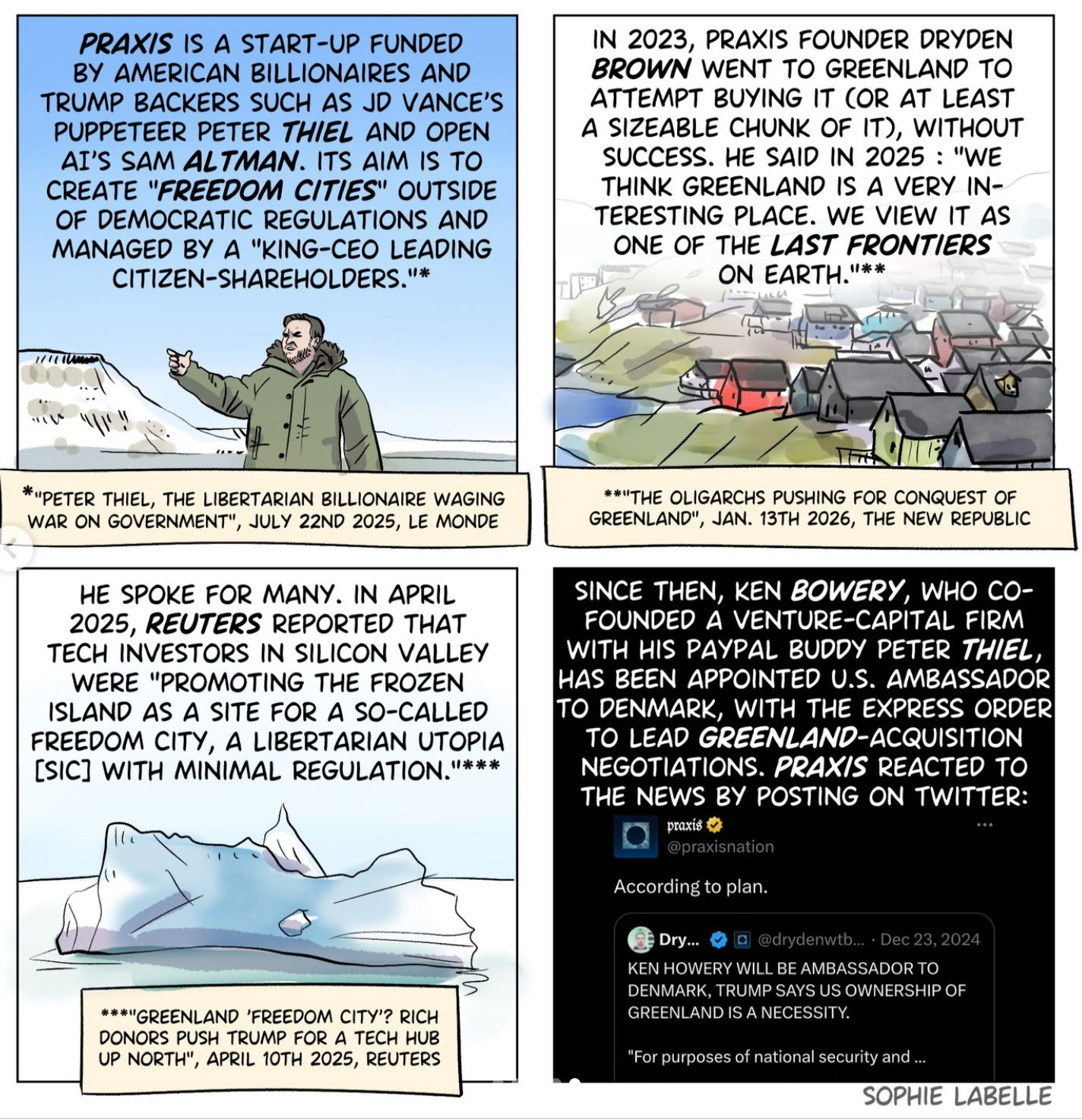
Here’s the text of the second panel:
In 2023, Praxis founder Dryden Brown went to Greenland to attempt buying it (or at least a sizeable chunk of it), without success. He said in 2025: “We think Greenland is a very interesting place. We view it as one of the last frontiers on earth.” (Source for the Brown quote: Casey Michel for The New Republic “The Oligarchs Pushing for Conquest” January 19, 2026.)
Dryden Brown, who is 29, would appear to be very interesting himself, but he doesn’t have his own Wikipedia page. Here’s how the Wiki entry for “Praxis (proposed city)” introduces him:
Dryden Brown was raised in Santa Barbara, California and was homeschooled in order to pursue competitive surfing. He stated that as a high schooler, he studied Ayn Rand and Austrian economists, and when he applied for college, he limited his applications to Harvard University, Stanford University, the University of Oxford, and the University of Cambridge. He was rejected by them all and he attended New York University before dropping out.
A 2023 story in Mother Jones provided a few more biographical details: Brown’s father “worked in private equity and owned a seven-bedroom, 6,200-square-foot home that recently sold for more than $6.5 million.”
Yes, I felt that familiar full-body twitching at the mention of Ayn Rand, the “Objectivist” author of the bad novels Atlas Shrugged and The Fountainhead. They’re frequently the only novels that “libertarian utopians” boast of having read.
And, as surely as “utopia” follows “libertarian,” PRAXIS is the name they default to for their endeavors.2
I say this with confidence because I have been naming companies for more than 30 years, and I guarantee you that every time clients — especially but not exclusively tech clients — attempt a DIY naming round, PRAXIS inevitably appears at the top of the list, right up there with NewGen and Omni. Just as Ayn Rand is the only author they know and love, PRAXIS is the Latin-via-Greek word they know and admire. They love that it means “practice as opposed to theory” — we’re doers, not thinkers! They love that it’s kind of esoteric — look how smart we are! They love that it contains X, symbol of the unknown.3 (The biggest X fan, of course, is Elon Musk.)
When I am consulted, I patiently say that yes, PRAXIS is an old word that definitely means something. But it’s overused, probably unavailable legally, and only a starting point in the naming process.
Some of those PRAXIS-lovers don’t listen, or never hire a branding consultant, and they push their babies through trademark registration. As a result, the U.S. trademark database contains more than 200 PRAXIS registrations, doubtless the tip of the PRAXIS iceberg. (Many names never get registered.) ETS, formerly known as Educational Testing Service, sells test-prep products called Praxis. There’s a Praxis Medicines (neurology therapies), a Praxis.co (“redemptive entrepreneurship”), a Praxis.tech (payments platform), a PraxisWorks (bicycle parts), Praxis mutual funds (“faith-based investing”). There are Praxis kitchen knives, Praxis bathtubs, Praxis Financial Partners, and numerous Praxis architecture firms. Unsurprisingly, there’s a Praxis AI (“Become the maestro of your own AI experience” — trite name, inapposite tagline).
And there’s Dryden Brown’s “Praxis Nation,” which I was unable to locate in the trademark database but which claims to have signed up 100,000 “Praxians” and raised $525 million from, as Gil Durán puts it in his invaluable Nerd Reich newsletter, “some of the most powerful people in tech” who want “to fuel a dystopian fantasy.” Powerful people like Peter Thiel, the billionaire co-founder of PayPal and Palantir4; and Sam Altman, the billionaire founder and CEO of OpenAI.

Praxis’s corporate slogan, “Reunite the West,” is explained on the home page: “Praxis is the world’s first Digital Nation, a home for the brave, who strive for virtue and wisdom. Our purpose is to restore Western Civilization and pursue our ultimate destiny of life among the stars.”
“Western Civilization” is frequently a dog whistle for “Christian nationalism.”

My beef here is with the PRAXIS name, which — like most classically sourced names — is overused to the point of meaninglessnes,5 and which sends a signal of careless branding strategy. Among its other weaknesses, it lacks emotional energy. (Read more about why this matters in my Medium story, “Creating names with emotional appeal.”) When a company founder chooses PRAXIS, he — it’s always he — has been listening only to the voices in his head and not to outside counsel.
But I’m also disturbed by the Praxis Nation raison d’être. Consider this quote from that 2023 Mother Jones story:
One former Praxis employee told me Brown believes that monarchy is superior to democracy. Another said his “worldview and ideal governance is authoritarian fascism—without religion—and instead the state party is holding everything together.” Think of a hybrid that would somehow resolve the tension between an all-powerful ruler and Rand’s Galt’s Gulch.
Or this, from Dryden Brown’s 2024 speech at the “First Praxis World Congress,” held in the “pop-up city” of Punta Cana, in the Dominican Republic:
We have no interest in being just another network state. States are bureaucracies. States merely exist. States maintain. But empires? Empires dream. Empires build. Empires unite. Empires transcend. A state operates within rules - an empire writes them. A state manages territory - an empire transforms civilization itself. When we say we're building a network empire, we mean we will create entirely new forms of human civilization.
Or this, from a Vanity Fair story published in July 2025, when Dryden Brown was still hoping to build his “acceleration zone” on Vandenberg Space Force Base, formerly Vandenberg Air Force Base, near Santa Barbara, California. Here Brown was ad-libbing without benefit of speechwriters:
In Vandenberg, one gets the sense that Brown is only just getting started. “When I think about Vandenberg…like, What is Vandenberg?” Here, he seemed to ponder the possibilities. “Vandenberg is a spaceport. It’s a portal to the stars. What are the stars? What is out there? It’s a great theater for heroism, for heroic exploration. It’s, like, space…space is not about mining rocks. It’s not about getting some metal off some rocks—that is gonna be handled by AI and robots. What it’s about is building new cultures and new worlds. That’s what it’s about. It’s about expanding human civilization to new places and giving it new forms.”
Now Brown and his powerful backers are setting their sights on Greenland. Does it make sense? Not to me. But maybe that’s because I’m thinking too much about the dumb PRAXIS name and not enough about what Casey Michel is warning us about in The New Republic:
Buried within the kind of crony capitalist network that has propelled Trump’s imperialism is something far stranger, and far darker, than simply seizing Greenland’s resources for financial gain. It’s about the opening salvos in a world in which any restrictions on American oligarchy—any oversight, any democratic checks, any hurdles whatsoever—are removed, and a golden, pro-oligarchic age reigns, centered on, but by no means limited to, Greenland.
Coincidentally (or not?), I’m currently reading How to Hide an Empire: A History of the Greater United States, by the American historian Daniel Immerwahr. Published in 2019, it’s more relevant than ever, as “empire” and “imperialism” are no longer seen as outdated and unacceptable concepts but are pursued without embarrassment by powerful Americans.
Praxis’s original name, when Dryden — then all of 23 — founded the company in 2019, was Bluebook Cities. Was it named for the blue book exams that Dryden never took during his aborted university career? Or borrowed from Kelley Blue Book, the standard reference for auto pricing in the U.S.? I don’t know.
Not to mention, as I wrote back in 2014 in a column about “X” in naming: “It doesn't hurt that X looks cool: linear, angular, symmetrical.”
Thiel likes to name his companies after magical objects in the Lord of the Rings trilogy: Palantir, Anduril, Mithril. If today’s masters of the universe have read a book that wasn’t written by Ayn Rand, that book was written by J.R.R. Tolkien. Read Michiko Kakutani on “Why Silicon Valley’s Most Powerful People Are So Obsessed with Hobbits” (gift link).
“Praxis” does have a meaning specific to Christianity — it’s how the Gospel is to be lived in the world — which explains why it appears in some “faith-based” organization names like the “redemptive entrepreneurship” Praxis.
“faith-based investing” made me laugh out loud.
Thanks, Nancy. This helps explain Trump's Greenland fixation. All these men, with all the money in the world. Making and ruling their own worlds. Invulnerable. Shameless. All of them pulling Trump's strings. He listens to them. But he's invulnerable— a dim, demented, shameless, psychotic king, feared by everyone. Especially Republicans.
This is scary.
Possible tags: Praxis Makes Perfect • Praxis of Evil • Praxis Shrugged