

How Rockefeller Center got its name
There's more to the story than you'd think.

Rockefeller Center, the complex of buildings that occupies 22 acres in midtown Manhattan, wasn’t supposed to be called Rockefeller Center. In its early planning stages it was called Metropolitan Square, after the Metropolitan Opera Company, the property’s intended principal tenant. But after the 1929 Wall Street crash the Met couldn’t afford to move from the 39th Street property it had occupied since 1883, and John D. Rockefeller Jr., the site’s developer (and only son of Standard Oil co-founder John D. Rockefeller Sr.), turned instead to the Radio Corporation of America (RCA) to help fill the vast new space. Part of the complex became known as Radio City. But what to call the whole thing?
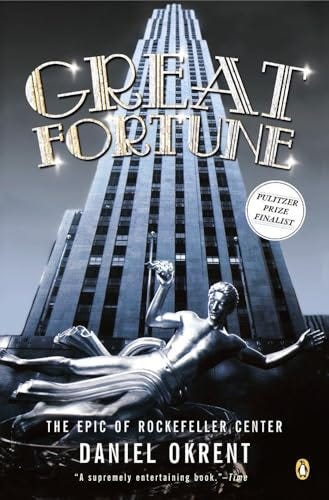
A new name “wasn’t an automatic,” writes Daniel Okrent in Great Fortune: The Epic of Rockefeller Center (2003). (I recommended the book in my recent Culture Diet post.) Junior, as he was known, was as reticent as his father had been “larger than life”:
The idea of having his own surname “plastered on a real estate development” had never occurred to Junior, and when it was first broached it appalled him. Metropolitan Square had the virtue of bland anonymity and, at the same time, a descriptive connection to the opera company. Radio City came from the RCA lease[.] … But Metropolitan Square had become an atavism, and Radio City would not do for the whole development, tainted as the words were by the scent of showbiz.
It was Ivy Ledbetter Lee, one of the founders of the public-relations industry and a consultant to the Rockefeller Center project from the beginning, “who first suggested ‘Rockefeller Center’ to Junior, in the summer of 1931,” Okrent writes.1 John R. Todd, the center’s principal builder and managing agent, liked the idea:
“It’s your money,” he told Junior. “Why not use the name?” Nothing would draw tenants more effectively, and everyone agreed that drawing tenants was a good thing. Junior still thought it “flamboyant and distasteful,” but the prospect of empty buildings was distasteful, too.
That left one big question about the name: Would it be Center or Centre?
The issue could have been a straightforward one: Center is the preferred American spelling; centre is British (and Canadian and Australian, etc.). But Junior happened to prefer Centre. Other advisers, writes Okrent, “were sure Center was the right spelling and it was soon apparent that this was something that could be resolved only by importing that always purchasable commodity, expertise.” In this case, the expertise of a famous lexicographer, Frank Horace Vizetelly.
How significant was the decision? The New York Times gave it front-page coverage on May 15, 1932:
When the Rockefeller interests finally hit upon a name for their new $250,000,000 mid-town office and amusement project, it was thought that their troubles were at an end. That is, except for the little matters of renting several million square feet of space and terminating construction delays occasioned by the strike of building workers in New York. But the name no sooner had been decided than the question arose as to whether it should be spelled Rockefeller “Center” or “Centre.” The most reputable dictionaries failed to settle this knotty problem. Some held the proper spelling was “centre”; others, that it was “center”; Lexicographers were consulted, but they also were at variance in their opinions. At last, Dr. Frank H. Vizetelly, editor of the New Standard Dictionary, was asked. He held that the spelling “centre” was the result of Norman French influence upon the English language. Shakespeare, he said, used “centre”; and so did Milton in “Paradise Lost.” Ten years later, however, Milton, in “Paradise Regained,” used “center.” It was decided, finally, to stick to the latter form.
Frank Horace Vizetelly may not be a household name today, but he was something of a word-hoard star in the early 20th century. Besides his day job at the dictionary publisher Funk & Wagnells he published some 200 works, including Mend Your Speech (1920), in which he tsk-tsked that “slovenly speech is as clearly an indication of slovenly thought as profanity is of a degraded mind.”
Here’s Okrent:
It was Vizetelly who had famously discovered that in seventy-five speeches delivered between 1913 and 1918, Woodrow Wilson had used exactly 6,221 different words. It was Vizetelly who had forcefully argued that a proper English alphabet would have sixty-five different characters. It was Vizetelly who claimed to know fifty synonyms for “money.”
Clearly this was a man who knew his center from his centre.
And what about his own unusual name? Okrent doesn’t go into it, so I did a little investigating.
Vizetelly was born in England in 1864 into a family of journalists and publishers who traced their British roots to the 17th century; their surname had been Anglicized from the Italian Vizzetelli. In a 1931 article, “What’s Behind the Name,” The Atlantic explained the etymology, using our friend Frank Horace as the example:
The name of a well-known lexicographer, for example, is to be traced to a physical characteristic — long sight. It is a corruption of the Italian visiatello, a word that means farsighted. The name was spelled Visiataly in old English registers; an ancestor, the first Henry Vizetelly, was buried in the parish of Saint Botolph’s, Bishopsgate, London, in 1691. Early forbears [sic] left Italy for England in the days of Mary Tudor.
Switch the syllables of Vizetelly (or Vizzetelli), and you can discern television, a word that was cobbled together in 1907 to describe what was then a hypothetical technology: a device that could see far. That coinage was not universally beloved. Purists like C.P. Scott, the British publisher and politician, sniffed at television’s hybrid origins. “The word is half Latin and half Greek. No good can come of it,” Scott is reported to have said sometime before his death in 1932. Not very farsighted of him!
Related, more or less:
Stop naming buildings (and streets, and parks, and ships, and mountains) after people

I originally published a version of this story on Medium in 2021. I’ve edited and updated it in light of recent news reports about labor leader César Chávez (1927–1993), whom the AFL-CIO website calls “a folk hero and a symbol of hope for millions of Americans.”
The Georgia-born Lee (1877–1934) had coined the phrase “enlightened self-interest” to describe, as Okrent writes, “why it was sometimes good to do well, and vice versa.”
It's a good thing they didn't call it Rockefeller Centre, otherwise it would have eventually achieved its destined identity as a Long Island shopping mall.
No idea why "theatre" looks fine to me but "centre" seems an abomination.